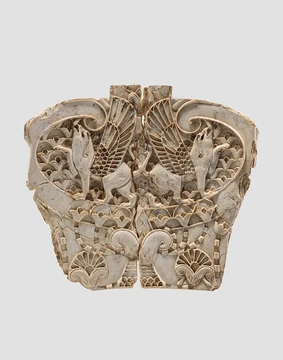
Chair
A seat for one, with back and legs.

A chair is a type of seat, typically designed for one person and consisting of one or more legs, a flat or slightly angled seat, and a back-rest. It may be made of wood, metal, or synthetic materials, and may be padded or upholstered in various colors and fabrics. Chairs vary in design, including armchairs, recliners, rocking chairs, and wheelchairs.
- earliest known use
- c. 3100 BC (Early Dynastic Period of Egypt)
- etymology
- from Greek καθέδρα kathedra ('seat, throne')
- common materials
- wood, metal, synthetic materials, stone, acrylic
- typical seat height
- 17 inches (43 cm) for mass-produced chairs
- common features
- legs, seat, back-rest; optional armrests, padding, upholstery
Lore & Background
The chair has been used since antiquity, although for many centuries it was a symbolic article of state and dignity rather than an article for ordinary use. 'The chair' is still used as the emblem of authority in the House of Commons in the United Kingdom and Canada, and in many other settings. It was not until the 16th century that chairs became common; until then, people sat on chests, benches, and stools.
Reader's Guide
Chairs have existed since at least the Early Dynastic Period of Egypt (c. 3100 BC). In ancient Egypt, chairs were often of great richness and splendor, fashioned of ebony and ivory or carved and gilded wood, and covered with costly materials. The higher ranked an individual, the taller and more sumptuous the chair. The average Egyptian family seldom had chairs. In China, the earliest images of chairs are from 6th-century Buddhist murals and stele, but chairs did not become widespread there until the 12th century. In Europe, the Renaissance caused the chair to cease being a privilege of state and become a standard item of furniture. The Industrial Revolution made chairs much more available. The 20th century saw increasing use of technology in chair construction, including all-metal folding chairs, moulded plastic chairs, and ergonomic chairs. The modern movement of the 1960s produced new forms such as the butterfly chair, bean bags, and the egg-shaped pod chair. Chair design considers intended usage, ergonomics, size, stacking ability, folding ability, weight, durability, stain resistance, and artistic design.
Did You Know?
- The word 'chair' comes from the early 13th-century English word chaere, from Old French chaiere, from Latin cathedra, and ultimately Greek καθέδρα kathedra.
- In ancient Egypt, chair seats were sometimes only 10 inches (25 cm) high.
- A Latvian interior designer created a volcanic hanging chair handmade out of volcanic rock.
Historical Roots & Early Pioneers
The concept of furniture designed for easy disassembly stretches back centuries, as cabinetmakers long crafted pieces that could be taken apart for transport. A more concrete early example is the Thonet No. The enterprise proved short-lived, and the total number of kits ever sold remains unknown.
Mid-Century Experiments & the Scandinavian Breakthrough
The 1940s and 1950s saw a new wave of entrepreneurs testing the flat-pack model. In Australia, Frederick Charles Ward, troubled by the scarcity of affordable furniture for working-class households, founded a mail-order ready-to-assemble business in the late 1940s. Across the Atlantic, Ohio cabinetmaker Erie J. Sauder earned the first U.S. Perhaps the most famous origin story belongs to Swedish technician Gillis Lundgren, who reportedly had to saw the legs off a table just to fit it in his car.
Economics & the Assembly Ecosystem
The flat-pack model creates a straightforward economic advantage for both seller and buyer. Once assembled, furniture becomes bulky, which drives up the costs of warehousing and last-mile delivery. By shifting the final assembly step onto the consumer, manufacturers can offer a lower retail price. The typical kit arrives in a flat carton containing the component parts, printed instructions, and often the necessary hardware such as hex keys. For shoppers who prefer not to take on the task themselves, an entire furniture assembly service industry has grown up, providing trained professionals who will put the pieces together for a fee. This division of labor—factory produces, consumer assembles or hires someone to—keeps the overall cost well below that of pre-built, ready-to-use furniture. The result is a product category that appeals to budget-conscious buyers who are willing to trade a small amount of time and effort for meaningful savings.
Materials, Manufacturing & Product Range
Most ready-to-assemble furniture is manufactured from particle board or medium-density fibreboard rather than solid wood, a choice that significantly reduces production costs. The lower-grade timber is then coated with a polymer laminate that mimics the grain and color of various hardwoods, yielding a finished surface that looks far more premium than the raw material would suggest. This combination of economical substrate and decorative veneer is what allows the category to deliver a high-quality appearance at a fraction of the price of solid-wood pieces. The product range spans an impressive breadth of household needs: living-room seating, office desks, bookcases, dining and side tables, beds, lounge-ware, outdoor and patio sets, swingsets, kitchen cabinets, CD and DVD storage racks, wardrobes, and closets. Whether a consumer is furnishing a single bedroom or outfitting an entire home, the flat-pack format makes a wide array of furniture accessible without the premium attached to pre-assembled, bulky goods.
Frequently Asked Questions
What is Chair?
Chair is a single-person seat built around a flat or gently angled sitting surface, a back-rest, and one or more supporting legs. It can be fashioned from wood, metal, or synthetic materials, and often comes with padding or fabric upholstery.
What are Chair's standard specs?
A mass-produced Chair typically sits at a seat height of roughly 17 inches (43 cm). Its core structure consists of legs, a seat, and a back-rest, with armrests and upholstery being optional extras.
When did Chair first appear in the historical record?
The earliest known example of a Chair dates to around 3100 BC, during Egypt's Early Dynastic Period.
What materials make up Chair?
Common construction materials include wood, metal, synthetic materials, stone, and acrylic. The finish may be plain or padded and upholstered in a range of colors and fabrics.
What is the origin of the name 'Chair'?
The word traces back to the Greek kathēdra (kathedra), which meant a seat or throne.
More in Home And Furniture 1-23
Spotted an error? Know more?
This is a living reference — every entry is fact-audited, and reader corrections feed straight into our audit queue. Suggest an edit · See this site's audit record