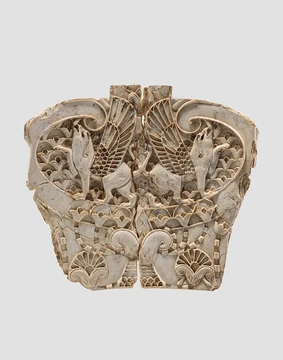
Carpet
Textile floor covering with pile attached to a backing.

A carpet or rug is a textile floor covering that typically consists of an upper layer of pile attached to a backing. The terms carpet and rug are often used interchangeably, although rugs are generally smaller and loose-laid. Since the 19th century, there has been a trend toward the production of fitted carpets, including wall-to-wall carpeting that is fixed in place. Carpets provide cushioning, sound and heat insulation, and are often decorated with patterns and motifs. They can be produced through various methods, including weaving, needle felting, hand-knotting, tufting, flat weaving, hooking, and embroidery.
- first_use_in_English
- late 13th century
- original_meaning
- coarse cloth
- shift_to_floor_covering
- 15th century
- common_modern_materials
- wool, polypropylene, nylon, polyester
- typical_widths_in_US
- 12 or 15 feet (3.7 or 4.6 m)
- typical_widths_in_Europe
- 4 or 5 m (13 or 16 ft)
- dominant_yarn_constructions
- polyamides (nylons) and polypropylene
Lore & Background
The term carpet was first used in English in the late 13th century, meaning 'coarse cloth', and by the mid-14th century referred to a tablecloth or bedspread. The word comes from Old French carpite, from Medieval Latin or Old Italian carpita, possibly from Latin carpere 'to card, pluck'. The Latin word was introduced in the 13th century by the Florentines from the Middle Armenian word կարպետ (carpet). The meaning shifted in the 15th century to refer to floor coverings. Carpets can be produced through various methods. Woven carpets are made on a loom, with pile that can be plush (cut pile) or Berber (loop pile). Flatweave carpets interlock warp and weft threads. Knotted pile carpets use supplementary weft attached by symmetrical (Turkish) or asymmetrical (Persian) knots. Tufted carpets have pile injected into a backing material. Hooked rugs are made by pulling strips of cloth through a sturdy fabric. Embroidered carpets use stitches on a cloth base. Needle felt carpets are produced by felting synthetic fibres with barbed needles. In Europe, pile was traditionally made of wool, but since the 20th century synthetic fibres such as polypropylene, nylon, and polyester have been used as less expensive alternatives. Nylon is one of the most common materials for carpets, with both nylon 6 and nylon 6-6 used. Nylon can be dyed topically or in a molten state, prints easily, and has excellent wear characteristics. Due to its broad availability and lower costs compared to natural fibres, it is widely used in industrial and commercial carpeting.
Reader's Guide
Carpets have been significant as floor coverings since the 15th century, evolving from coarse cloth and table coverings to fitted, wall-to-wall installations. Their importance lies in providing cushioning, sound and heat insulation, and decorative versatility. Technological developments have made inexpensive mass-produced synthetic carpets widely available, alongside more costly hand-knotted wool rugs. The shift from natural to synthetic fibres in the 20th century transformed the industry, with nylon and polypropylene dominating commercial production. Carpets are manufactured in standard widths and installed using various fastening methods. The distinction between carpet and rug remains fluid, with carpet often referring to wall-to-wall or high-quality finished pieces, while rugs are smaller and loose-laid. The legacy of carpet production includes both industrial methods and traditional handcrafts such as hand-knotting in regions like Turkey, Iran, India, Pakistan, and the Middle East. The cultural importance of carpets is exemplified by Turkmenistan's national flag, which features five carpet guls.
Did You Know?
- The term carpet was first used in English in the late 13th century, meaning 'coarse cloth'.
- The Latin word 'carpet' was introduced in the 13th century by the Florentines from the Middle Armenian word 'կարպետ' (carpet).
- The two main types of knot in knotted pile carpets are the symmetrical (Turkish or Ghiordes) and asymmetrical (Persian or Senna).
- The national flag of Turkmenistan features a vertical red stripe containing five carpet guls.
Founding & Early Struggles
Rose Blumkin, a Belarus-born entrepreneur known as Mrs. Her initial capital was a modest $500 borrowed from her brother, while her husband Isadore continued managing their existing secondhand clothing shop. The early years were financially precarious at times; the Blumkins even had to liquidate their own household furnishings to settle a debt. Mrs. B. distinguished her operation by pricing products below every other furniture retailer in the area. This aggressive strategy backfired temporarily when larger competitors pressured suppliers to cut off the Mart. Rather than capitulate and raise prices, she traveled to source inventory from vendors across the country, maintaining her underpricing advantage. This tenacity laid the groundwork for a business that would eventually span multiple states.
The Buffett Deal & Mrs. B's Legacy
B. sold an 80% stake in the Mart to Warren Buffett for $60 million in what amounted to a one-page handshake agreement. Notably, Buffett conducted no audit of inventory or financial records; his confidence rested on his personal shopping experiences at the store and his regard for the Blumkin family. Mrs. B. explained her decision as a practical move to prevent her children from quarreling over the business after her passing. Remarkably, she continued working her customary 70-hour weeks, navigating the floor on an electric scooter. Buffett later remarked that pitted against top business-school graduates or Fortune 500 CEOs with equal resources, she would outperform them all.
Expansion & Growth
What began as a single Omaha location grew into a multi-state operation. NFM president Ron Blumkin initially told Buffett there were no plans for further expansion. By 2011, that stance had shifted, and the company announced its fourth and largest location in The Colony, a far-north Dallas suburb.
Scale & Store Operations
The physical footprint of NFM's locations is staggering. The Kansas City store, situated across from the Kansas Speedway, has attracted visitors from across the United States, functioning as much of a tourist destination as a retail outlet.
Frequently Asked Questions
Who is Carpet?
Carpet is a textile floor covering built from an upper pile layer bonded to a backing, and it is generally larger and fixed in place compared to a loose-laid rug.
What does Carpet do for a room?
It cushions footsteps, dampens noise, and adds thermal insulation, often serving as a decorative focal point through woven patterns or motifs.
When did Carpet first appear in the record?
The English word dates to the late 13th century, where it originally described a coarse cloth, and only by the 15th century did it settle into its current meaning as a floor covering.
What is Carpet typically made of these days?
Modern carpets most commonly use wool, polypropylene, nylon, or polyester as their primary fiber, produced through methods such as weaving, tufting, or hand-knotting.
How wide does Carpet usually come?
Standard roll widths in the United States are 12 or 15 feet (about 3.7 or 4.6 m), while European rolls typically measure 4 or 5 meters (roughly 13 or 16 ft).
More in Home And Furniture 1-23
Spotted an error? Know more?
This is a living reference — every entry is fact-audited, and reader corrections feed straight into our audit queue. Suggest an edit · See this site's audit record